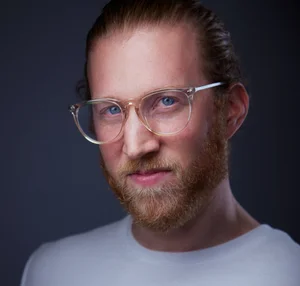
Retouching For “Real”
Clients don’t consciously analyze your headshots — but they absolutely register them.
Companies invest heavily in how their environments are perceived. A well-designed website, an impressive office, quality furniture, etc. This intentional presentation signals something important to clients and prospects alike.
With headshots, it's the same concept but presenting the people - on Zoom, LinkedIn, email signatures, websites, and proposal decks. And just like physical space, those visuals communicate standards.
And when you factor in how many times a person’s headshot appears, across these channels, it’s clear this is not an asset to be overlooked.
Filters vs. Professional Retouching
The rise of image editing apps, filters, and AI tools has made it easier than ever to be a “photo editor” and produce decent results. Conservatively speaking, we could say it’s fairly easy to get a decent headshot just by a $5 app. But, ignoring the lack of control and intent, what they often deliver is a look that feels generic — and yes, artificial.
In order to operate quickly, results have over-smoothed skin, flattened texture, and a general loss of detail. Since a large difference between human and AI is taste, you sacrafice the ability to balance small human details that play an important role in giving that elevated look. It’s the difference between shooting a video on iphone (very much passable for many cases), and shooting on a $50,000 Red Camera for cinema (“that looks professional”).
Ironically, the tools meant to make an image feel more refined often undermine the reason companies invest in professional photography in the first place: resolution, clarity, and realism. And as the floor rises in terms of accessibility to a “professional headshot” the need for companies to invest in the real thing grows, as a way to distinguish themselves, because professional retouching by hand is the only way to retain those details, providing that distinguished look.
AI retouching is like trying to produce tailored suits at mass scale, it just doesn’t work. You need to process each individual, individually.Hand stitching instead of machinery, tape measures that account for an arm than isn’t an even 34”, but maybe 34.2”. These additinoal levels of care are what produce that additional 5-10% of quality, that the high end client notices. Again, not always consciously, but absolutely subconsciously.
It allows for selective reduction of distractions — a blemish here, uneven tone there — without erasing the texture that makes someone look like themselves.
Perception Follows Presentation
When the presentation of your individuals looks high-end, the assumption is the people are high quality.
When a person’s image appears across LinkedIn, emails, decks, and websites, it becomes part of how competence is inferred.
But there is even another layer at play, that perhaps matters more than ever now.
When the people on a website etc. look like people, the assumption is you are working with people — not chatbots.
In an era increasingly shaped by AI-generated everything, real human presence carries weight, again, particularly in businesses that demand quality care and client experiences.
Competition Comparison
Imagine viewing two company websites: One features a mix of selfies and randomly cropped images.
The other presents a unified set of headshots that feel closer to editorial photography than snapshots.
Other than that, each company offers essentially the same services and makes similar claims. The only difference is presentation.
Without reading a word, human nature dictates assumptions will form.
About leadership, attention to detail, and positioning in the market. It would be safe to assume the company with standardized headshots tended to details beter, cared more about its employees, and was likely the industry leader between the two if for no other reason than they had the funds to invest in high end team headshots.
The Role of Retouching in The Results
Retouching is the final step that determines how real an image looks, and therefore whether the image supports or weakens the brand perception.
Done poorly, it will strip away realism, and often undermind the purpose of having your team photographed professionally.
Done well, it removes blemishes, soften distractions, and amplifies the natural beauty of an image, keeping texture intact, balancing color tones, and presenting someone as they would in the real world.
Turnaround Time for Retouched Images
Please refer to the following estimates for final image delivery, including retouching and crops. Rush delivery is available for $50/image and express sessions are available to corporate clients who need to book a 1-off session.
Express sessions are available as 30 minutes or 60 minute options which include 1 or 2 images, respectively — perfect for new hires, promotions, award winners, speakers, or individuals who could not attend the main group session.
<20 Images: 2-5 Business Days
20-50 Images: ~10 Business Days
50-100 Images: 10-15 Business Days
Express Sessions: 1-2 Business Days
The Investment
In the article about expression coaching, we suggested that if your company headshots are just a collection of forced, uncomfortable smiles - even under the best lighting with the most careful retouching - you’re still effectively working with ID badges. Assets that mainly serves to confirm or deny whether somebody is who they claim.
To go beyond this binary function and actually benefit from headshots, it needs to be seen as a marketing tool, and just like coaching towards great expressions, the retouching cannot be done haphazardly, or you diminish the image just like you do with a corny expression.
For companies invested in branding, our approach to retouching offers you team headshots that can become a valuable extension of the marketing efforts.